
The Comprehensive Commercial Property Fire Safety Checklist for 2026

Your fire safety strategy is no longer just about a few extinguishers and a paper logbook; it is now a sophisticated intersection of electrical health, digital security, and rigorous compliance. Maintaining an up-to-date commercial property fire safety checklist is essential for any business owner who feels the weight of evolving British Standards and the threat of heavy fines. Many professionals find it difficult to manage separate contractors for fire alarms, CCTV, and electrical installations without losing oversight. A methodical approach to these requirements replaces confusion with a sense of established stability and quiet confidence.
This guide provides a professional roadmap to ensure your premises remain legal, protected, and fully prepared for any inspection in 2026. We will walk you through the essential steps of a comprehensive audit and explain how to integrate your safety measures with modern digital infrastructure, including electronic monitoring and enhanced cybersecurity. By following this structured path, you can unify your building's systems into a single, resilient ecosystem. This process ensures your protective measures are both technologically advanced and fully compliant with current UK regulations.
Key Takeaways
Understand the legal framework of the Regulatory Reform (Fire Safety) Order 2005 and how a comprehensive commercial property fire safety checklist serves as your primary tool for audit readiness.
Learn to distinguish between addressable and conventional alarm systems to ensure your detection technology is suited to the scale and complexity of your business premises.
Verify that your physical safeguards, including emergency lighting and escape routes, meet the specific requirements of BS 5266-1 for permanent visibility and safety.
Explore how to integrate your fire alarms with CCTV and access control systems to automate door releases and monitor evacuations in real-time.
Discover the administrative requirements for staff training and the fire warden role to maintain continuous safety awareness beyond the standard annual drill.
Table of Contents
What is a Commercial Property Fire Safety Checklist?
A commercial property fire safety checklist is a structured framework used to audit the physical, technical, and administrative fire safeguards of a business premises. It serves as a living document that ensures every element of your protective infrastructure is functioning correctly and remains compliant with current UK law. In 2026, the focus for facility managers has shifted away from reactive repairs. Instead, modern checklists prioritise preventative maintenance and the seamless integration of Active Fire Protection Systems with broader building management technology. This methodical approach replaces the fear of inspection with the confidence that your building is a safe pair of hands for its occupants.
The legal accountability for maintaining this documentation rests with the "Responsible Person". This individual is typically the employer, the building owner, or the person in control of the premises. They carry the burden of ensuring the building is safe for employees, visitors, and emergency services. Failure to maintain an accurate commercial property fire safety checklist can lead to severe penalties, including unlimited fines or prosecution. By treating this document as a proactive roadmap rather than a bureaucratic hurdle, businesses can identify potential vulnerabilities before they escalate into critical failures.
The Legal Framework: Regulatory Reform Order 2005
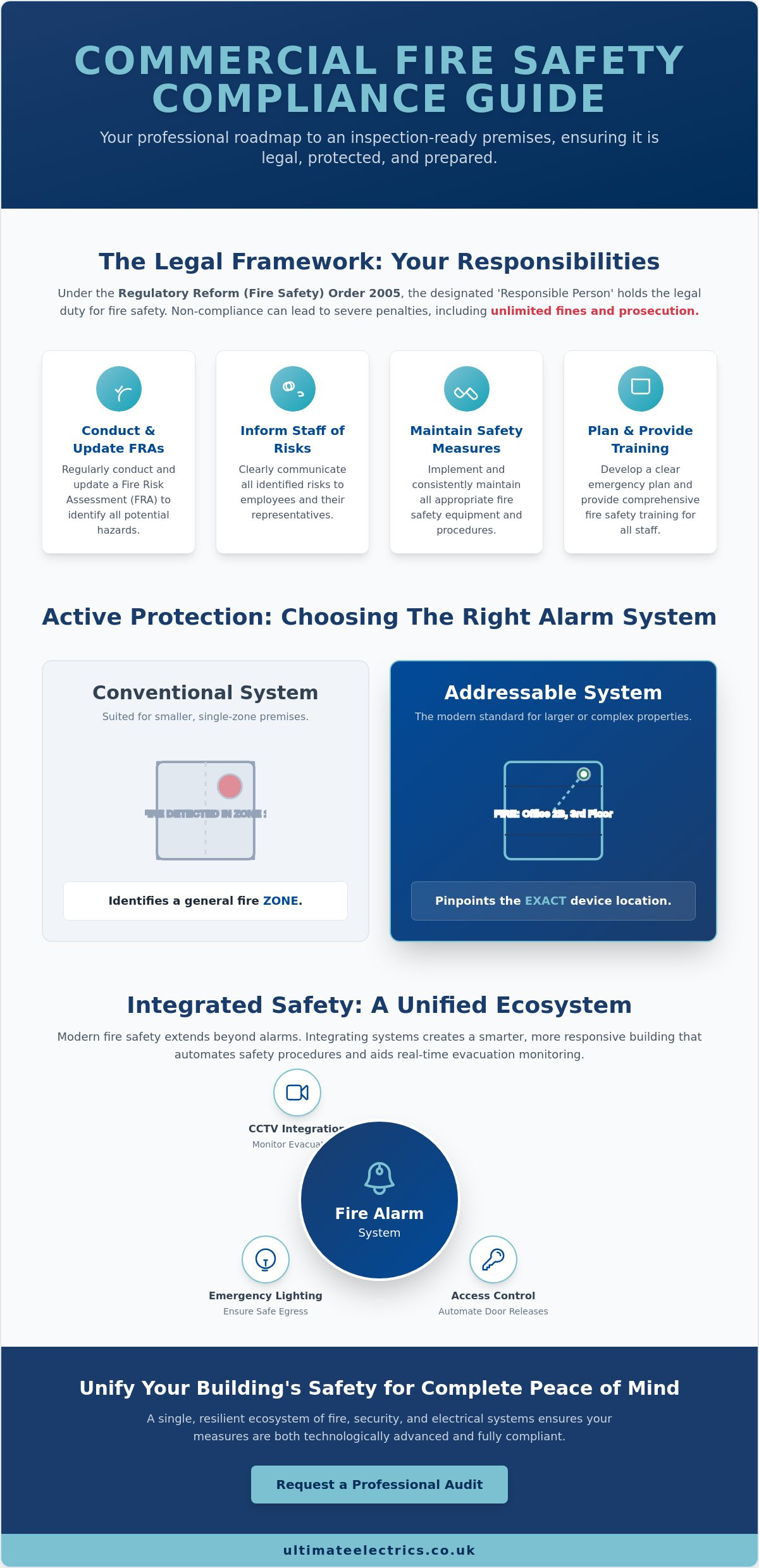
The Regulatory Reform (Fire Safety) Order 2005 is the primary legislation for UK workplace fire safety. It applies to almost all non-domestic premises, including shared office blocks and multi-tenanted industrial units. In these complex environments, the order requires cooperation between different stakeholders to ensure that communal escape routes and shared alarm systems are managed as a single, cohesive unit. Compliance involves several core duties for the Responsible Person:
Conducting a regular Fire Risk Assessment and keeping it updated.
Informing staff and their representatives about the risks identified.
Putting in place, and maintaining, appropriate fire safety measures.
Planning for emergencies and providing staff with adequate fire safety training.
The Role of the Fire Risk Assessment (FRA)
Every effective commercial property fire safety checklist begins with a Fire Risk Assessment (FRA). This is a mandatory legal requirement that identifies potential hazards and evaluates the risk to people on-site. While some small businesses might attempt a generic assessment, complex commercial properties require a site-specific professional audit to be truly effective. An FRA becomes invalid if there are significant changes to the building layout, occupancy levels, or the type of work being carried out. At a minimum, you should review your assessment annually. This ensures it reflects the current state of your property and accounts for any technological updates in your electrical or security systems.
Active Protection: Fire Detection and Alarm Systems
Active detection systems serve as the primary sensory network of your building. A robust commercial property fire safety checklist must prioritise these systems to ensure early warning and rapid evacuation. The technology you choose depends entirely on your environment. Smoke detectors are essential for life safety in corridors and offices, whilst heat detectors are better suited for commercial kitchens or boiler rooms where steam or dust might trigger a false alarm. Multi-sensor detectors combine these technologies, using intelligent algorithms to differentiate between a real threat and a nuisance trigger, which is vital for reducing business downtime.
Choosing between addressable and conventional systems is a matter of scale and precision. Conventional systems are often sufficient for small, single-storey units, as they identify a general zone where a fire is detected. For larger or more complex premises, addressable systems are the standard. These provide the exact location of the triggered device on the control panel, allowing for a faster response from both on-site staff and emergency services. Professional Fire Alarm Systems integration ensures that these components work in harmony with your building's layout.
BS 5839-1 Compliance for Commercial Premises
BS 5839-1 is the British Standard that dictates the code of practice for the design, installation, and maintenance of fire detection systems in non-domestic premises. Compliance requires that your building is divided into clear zones so that the fire's origin is easily identifiable. A specialist electrical contractor plays a critical role here, ensuring that the system's integrity is maintained through correct wiring and panel configuration. This standard also mandates a professional inspection every six months. This deep diagnostic check covers battery health, signal strength, and sensor sensitivity, ensuring the system remains reliable when it's needed most.
Step-by-Step Fire Alarm Testing Procedure
Weekly testing is a fundamental administrative duty that verifies the system is operational between professional service visits. This process should be methodical and well-documented to satisfy any fire safety audit.
Step 1: Notify your alarm monitoring centre before starting. This prevents unnecessary emergency call-outs and ensures the system is correctly communicating with the centre.
Step 2: Actuate a manual call point. You should rotate the test point each week to ensure every device on the circuit is functional over time.
Step 3: Verify that all sounders are audible throughout the building and that visual indicators, such as beacons, are flashing correctly.
Step 4: Record the result in your fire logbook immediately. Note the location of the tested call point and any defects found, then arrange for a specialist repair if any part of the system fails.
Physical Safeguards: Escape Routes and Emergency Lighting
Physical safeguards represent the passive layer of your building's defence. Whilst detection systems provide the alert, your escape routes and lighting ensure that occupants can exit the premises safely. A commercial property fire safety checklist must confirm that all designated exit paths remain permanently unobstructed. It's common for corridors to become temporary storage areas for stock or deliveries, but even a minor blockage can become a lethal hazard in a smoke-filled environment. Signage must be photoluminescent or internally illuminated to remain visible if the primary power fails, guiding occupants toward the nearest exit without hesitation.
Suppression systems provide the final line of defence for both life and property. Portable fire extinguishers, sprinklers, and hose reels require rigorous maintenance to remain effective. Every piece of equipment should display a current service tag, indicating it has been inspected within the last twelve months by a competent person. For water-based systems, such as sprinklers, regular pressure checks ensure the network is ready to actuate. Integrating these physical checks into your monthly routine prevents the gradual degradation of safety equipment that often goes unnoticed until an emergency occurs.
Emergency Lighting Maintenance and the Flick Test
Emergency lighting must comply with BS 5266-1 to ensure adequate illumination along escape routes and at specific "points of emphasis". These points include stairways, changes in floor level, and external assembly points. You should conduct a monthly "flick test" to verify that every lamp actuates when the mains power is disconnected. However, a monthly check isn't enough to confirm battery health. An annual full-duration discharge test is required to ensure the batteries can power the lights for the full three hours mandated by UK safety standards. Many businesses are now transitioning to LED emergency lighting. These units offer superior reliability and lower energy consumption whilst reducing the frequency of lamp failures.
Fire Door Integrity and Compartmentation
Fire doors are engineered to contain heat and smoke within specific zones, a process known as compartmentation. Their effectiveness relies on three critical components: the self-closing mechanism, the intumescent seals, and the integrity of the door frame. You can perform a basic check using the "three-finger rule" to ensure gaps around the top and sides of the door don't exceed 3mm to 4mm. If the gap is too wide, smoke will bypass the door before the intumescent seals can expand. Propping open fire doors is a dangerous compliance failure that nullifies your building's fire strategy. Depending on the risk level, different areas will require either FD30 or FD60 rated doors, providing 30 or 60 minutes of protection respectively. Regular audits should verify that these doors haven't been damaged by heavy foot traffic or equipment movement.
Administrative Compliance: Training and Record Keeping
Human behaviour is often the most unpredictable element of a building's safety strategy. Even the most advanced detection systems cannot compensate for a workforce that is unprepared for an emergency. A robust commercial property fire safety checklist must therefore extend beyond hardware to include rigorous administrative protocols. Staff training should move away from the traditional annual tick-box exercise toward a culture of continuous safety awareness. This involves regular briefings on new hazards, updates to evacuation routes, and clear communication regarding any changes to the building's layout or occupancy levels.
Organising a fire drill requires a balance between realistic simulation and business continuity. Best practices suggest conducting drills at least twice a year, varying the time of day to account for different shift patterns. To minimise disruption, you can use "silent" drills where staff move to assembly points without full sounder activation, though at least one full-volume evacuation per year is essential. After each drill, you must record the evacuation time and identify any bottlenecks or failures in staff behaviour. This data allows you to refine your procedures and provides documented proof of your commitment to life safety.
Fire Warden Duties and Daily Checks
Fire wardens are the backbone of on-site safety management. Their role involves daily visual inspections, such as checking the alarm panel for fault lights and ensuring all final exit doors are clear of obstructions. You should determine the ratio of wardens to staff based on the complexity of your premises and your specific shift patterns; a common benchmark is one warden for every 20 employees in high-risk areas. Training for these individuals must be comprehensive, covering the correct use of extinguishers and specific protocols for assisting those with mobility issues. For businesses requiring professional oversight of their technical infrastructure, our team provides expert Fire Alarm Systems maintenance to support your internal safety wardens.
Logbook Management and Inspection Readiness
A Fire Officer will typically ask to see your logbook first during an unannounced inspection. Modern property managers are increasingly moving away from paper records in favour of digital logbooks, which provide a more secure and accessible audit trail. Every event must be recorded, including false alarms, staff training sessions, and visits from maintenance contractors. A well-maintained fire logbook is the primary evidence of a business’s "due diligence" in the event of a fire. Whilst your internal team handles daily checks, the validity of your administrative records depends on the underlying health of your systems. This is why the role of a specialist contractor is vital; they provide the certified maintenance reports that underpin your commercial property fire safety checklist and prove that your technical safeguards are fit for purpose.
Integrated Safety: The Synergy of Fire, Security, and Electrical Systems
Fire safety is most effective when it functions as an integrated component of your building's wider infrastructure. A comprehensive commercial property fire safety checklist must account for the interplay between fire detection, security hardware, and electrical health. Modern buildings rely on sophisticated technology to manage access and surveillance, but these systems must defer to the fire alarm panel during an emergency. CCTV, for example, serves as a vital fire management tool, allowing your team to verify alarms and monitor evacuation progress from a central point without entering high-risk zones. This synergy ensures that technology supports life safety rather than hindering it.
Access Control and Fail-Safe Mechanisms
Access control systems are essential for security, but they can become dangerous barriers during an evacuation if not correctly integrated. In a fire context, electronic doors must be configured as "fail-safe," meaning they automatically unlock when power is cut or the fire alarm is triggered. This differs from "fail-secure" locks, which remain locked to protect property but can trap occupants. Every fire alarm service should include a physical test of these door release triggers to ensure the link is active. Additionally, green break-glass units should be installed at each exit as a manual emergency override, providing a final layer of redundancy if the electronic trigger fails.
Preventative Electrical Maintenance (EICR)
Faulty wiring remains one of the leading causes of commercial fires amongst UK businesses. An Electrical Installation Condition Report (EICR) is a vital preventative measure that identifies overloaded circuits, lack of earthing, and general wear. By aligning your EICR schedule with your fire safety strategy, you address the root cause of many electrical fires before they start. Maintaining the health of your electrical installations is just as important as testing the alarm itself. Our 24 hour call out service ensures that building safety is maintained even during unexpected electrical faults, providing a safe pair of hands for your complex infrastructure needs.
Choosing a Specialist Integrated Partner
Managing multiple contractors for fire, security, and electrical maintenance often leads to "contractor fatigue" and fragmented safety protocols. Using a single specialist for CCTV and Access Control, fire alarms, and electrical installations creates a more efficient and cohesive safety strategy. This "all-in-one" approach ensures that the team understands how each system interacts, reducing the risk of integration failures. It provides a methodical, no-nonsense solution for property managers who value established stability and technical competence. A unified partner can oversee your entire commercial property fire safety checklist, ensuring that every technical safeguard is fit for purpose and fully compliant.
Ensure your property is fully compliant with a professional fire safety audit from Ultimate Electrical Group Ltd. Our highly organised team bridges the gap between traditional trade skills and modern technological innovation, ensuring your commercial premises remain legal, protected, and prepared for any inspection.
Securing Your Building's Future Through Integration
Achieving full compliance requires a shift from viewing fire safety as an isolated task to seeing it as part of a unified building infrastructure. A rigorous commercial property fire safety checklist ensures that your detection systems, physical safeguards, and administrative records work in harmony. By prioritising preventative maintenance and system synergy, you protect your occupants and your business from the risks of non-compliance and structural loss.
Our team acts as a safe pair of hands, serving as specialist fire alarm system installers who understand the intersection of safety and technology. We provide comprehensive integrated security solutions and 24-hour emergency electrical support to keep your premises operational around the clock. This methodical approach replaces the uncertainty of managing multiple contractors with the reliability of a single, highly capable partner. It ensures that your building is not just meeting a standard, but is actively resilient against evolving threats.
Book your comprehensive fire safety and electrical compliance audit today and gain the confidence that your building is fully prepared for the future.
Frequently Asked Questions
How often should a commercial fire risk assessment be updated?
You should review your fire risk assessment at least once every twelve months to ensure it remains valid. It's also mandatory to update the document if there are significant changes to the building layout, occupancy levels, or business processes. Keeping this assessment current is the foundation of any commercial property fire safety checklist, as it identifies new hazards that may have emerged since the previous audit.
Is it a legal requirement to have a fire alarm maintenance contract?
Yes, the Regulatory Reform (Fire Safety) Order 2005 requires that all fire safety equipment is maintained in an efficient state and in good repair. British Standard BS 5839-1 specifically mandates that a competent person carries out a professional inspection at least every six months. A formal maintenance contract ensures these legal deadlines are met consistently, providing documented proof of your compliance during an official inspection.
What is the difference between an addressable and a conventional fire alarm?
The primary difference lies in how specifically the system identifies the location of a fire. A conventional system indicates a broad zone, which is suitable for smaller, less complex buildings. An addressable system provides the exact location of the specific detector that has been triggered. This precision is essential for larger commercial properties where rapid identification of the incident source is critical for effective evacuation and emergency response.
Can I carry out my own commercial fire safety checks?
You can perform basic routine checks, such as weekly alarm testing and monthly visual inspections of escape routes. However, technical maintenance and system certifications must be completed by a competent specialist. Professional contractors have the technical literacy and calibrated equipment required to test sensor sensitivity and battery health, ensuring your building's protective measures meet the rigorous standards expected by insurers and the fire service.
How many fire wardens does my business actually need?
The number of fire wardens required is determined by your specific fire risk assessment rather than a fixed legal ratio. Factors include the size of the premises, the number of employees, and the nature of the work being performed. As a general guide, you should ensure enough coverage to manage an evacuation across all shifts, including allowances for holidays, sickness, and break times, to maintain continuous safety oversight.
What happens if my business fails a fire safety inspection?
Failing an inspection typically results in the fire authority issuing an informal notice or a formal enforcement notice detailing required improvements. In cases of serious risk, they may issue a prohibition notice that restricts access to the building until the issues are resolved. Serious or persistent non-compliance can lead to unlimited fines and criminal prosecution for the "Responsible Person" named in your fire safety strategy.
Do fire extinguishers need to be serviced every year?
Yes, fire extinguishers must undergo a professional service every twelve months to comply with BS 5306-3. This annual inspection ensures the units are pressurised, unobstructed, and capable of functioning correctly in an emergency. Beyond this annual requirement, your internal team should conduct monthly visual checks to verify that the safety seals are intact and the gauges are showing the correct pressure levels.
How does access control affect fire safety evacuation?
Access control systems must be integrated with the fire alarm to ensure all electronic locks release automatically during an emergency. This "fail-safe" configuration prevents occupants from being trapped behind secured doors whilst attempting to evacuate. It's essential that these integrated links are tested regularly as part of your commercial property fire safety checklist to confirm that security hardware doesn't compromise the speed and safety of an exit.



Comments